
SEO in 2026 Is Three Jobs Now — Here's What Changed
Ahrefs analyzed 146 million SERPs and 730,000 AI responses. The finding: SEO split into three distinct jobs. Here's what each one looks like.
Ahrefs looked at 146 million search engine results pages. They analyzed 730,000 AI-generated responses and roughly a million citations. What they found is not that search died, or that SEO is over, or any of the dramatic headlines the industry churns out every quarter.
What they found is that one job became three.
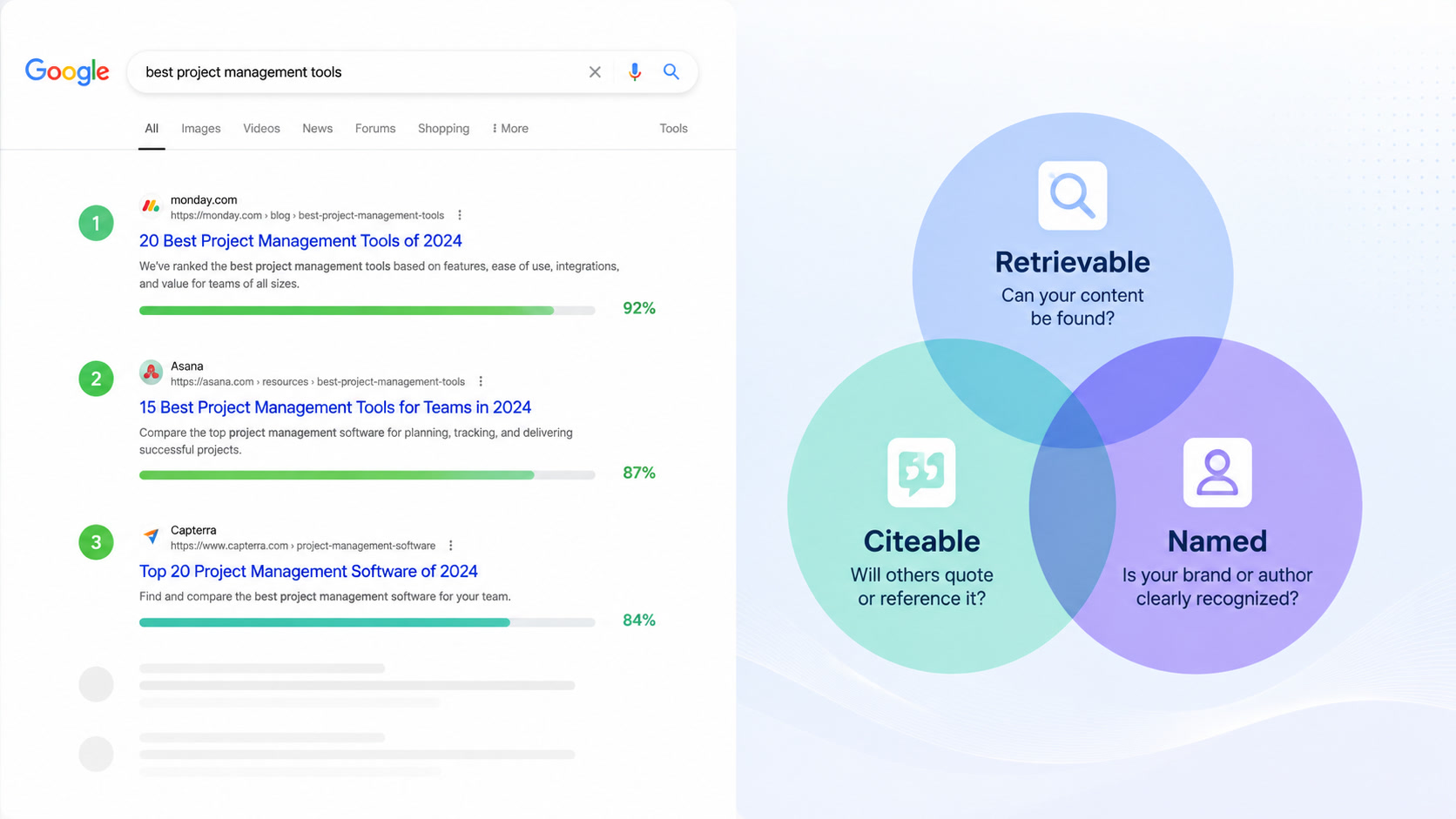
The old SEO role — write content, build links, rank in Google — still exists. But it no longer covers what you actually need. You now have to be retrievable so a model can find your page. You have to be citeable so the model will quote it. And you have to be trusted enough as a brand that the model names you or links you by choice.
Classic SEO covers part of all three. It does not cover all of any of them.
Here is what the data says, and what should change about your strategy because of it.
Job 1: Be Retrievable
The first job is the one that looks most like classic SEO. A model needs to crawl your page, render it, parse it, and decide it is relevant enough to include in its answer pool. If your page is blocked, slow, or badly structured, it never makes it into the candidate set.
The uncomfortable truth: being retrievable is not the same as ranking.
Ahrefs found that 28.3% of ChatGPT's top 1,000 cited pages had zero organic keyword visibility in their index. More than a quarter of the pages ChatGPT leaned on would not show up in a normal rank report at all. For AI Overviews, 31% of citations came from pages outside the top 100 search results.
That does not mean ranking is useless. Of AI Overview citations, 37.9% came from pages ranking in the top 10. Ranking clearly helps. But it is no longer the only path into the answer.
The practical takeaway: if your only scoreboard is position tracking, you are blind to the pages that models are already using. You need a separate retrieval audit — which pages does the model actually fetch, and which does it skip?
Start with your robots.txt, your important templates, and your server logs. A page that cannot be fetched cannot be cited, no matter how good the content is.
Job 2: Be Citeable
Being found is useless if the model reads your page and decides not to quote it. Job two is about making your content extractable.
This is where the old content playbook takes the hardest hit. The SEO industry has spent years telling people to write longer content. Google's own guidance has leaned that direction. The data says something different.
Ahrefs found near-zero correlation between word count and the odds of an AI Overview citation. More than half of cited pages — 53.4% — were under 1,000 words. Long does not mean quotable.
What does correlate with citations is format. For top-of-funnel queries, "best X" style blog lists made up 43.83% of ChatGPT's source URLs. Models reach for pages that already organize options into a clean, comparable answer, because that shape is easy to extract and summarize.
The fix is straightforward. Write for extraction, not for length. Put the answer near the heading that asks the question. Use comparison tables when the query implies a choice. Keep passages self-contained so a model can lift one without losing meaning. If your section does not make sense when separated from the rest of the article, it will not get cited.
Job 3: Be Named
The third job is the one most SEO teams are not measuring yet. Even when a model retrieves and cites your content, it may not mention your brand by name.
Ahrefs found that across six AI indexes, only 28% of brand mentions included a link. Perplexity was far more willing to attach a link than Google AI Overviews. Most of the time, the model talks about a brand without sending a clickable path to it.
That means an unlinked mention still shapes whether a model associates your brand with a category — even though it never shows up in a backlink tool or a referral report. You are winning the association without getting the click.
The strongest signal Ahrefs measured for brand visibility in AI responses was YouTube mentions, with a correlation of roughly 0.737 across ChatGPT, AI Mode, and AI Overviews. That is not proof that posting videos lifts citations, but it is consistent enough across three different surfaces to act on. At minimum, video and editorial mentions belong in the distribution plan next to links, not after them.
The defensive side of job three is owning the canonical story about your brand. Ahrefs also ran a misinformation test: they seeded false claims and watched which models repeated them. Gemini and Perplexity echoed the false claims in 37% to 39% of responses. ChatGPT 4 and 5 stayed below 7%. Claude avoided the false claims, but it also did not surface the official brand site — its own kind of failure if you are the brand that should have been named.
The move here is clear. Maintain pages that state what you do, who you serve, and the facts a model should repeat. Keep FAQs current so the right answer is easy to find and quote. When the web disagrees about you, the model needs a clean, well-structured source to prefer, and that source should be yours.
What This Means for Your Strategy
If the Ahrefs benchmark proves one thing, it is that the old single-scoreboard approach does not work anymore. You cannot track one ranking position and call it done.
You need three reports now.
A retrieval report. Which pages can models find? Which are blocked, slow, or unparseable? This is technical SEO with a new purpose: not just ranking, but being present in the model's knowledge base.
A citation report. Which prompts mention your content? Which page do they cite? This is not the same as your keyword ranking report, and it will not agree with it.
A brand mention report. Are models naming your brand? Are they linking to you? What are they saying in the answer itself?
The teams that win the next year of AI search will be the ones who treat these as three separate outcomes, track them separately, and optimize for each one with different tactics.
Rankings get you into the retrieval pool. Clear content gets you extracted. Brand distribution gets you trusted. Official answers protect you when the model is wrong.
That is the 2026 search job. One role, three scoreboards.
Frequently Asked Questions
Is SEO dead in 2026?
No. SEO is splitting into three distinct jobs: being retrievable (a model can find your page), being citeable (your content is structured for extraction), and being named (the model trusts your brand enough to mention it). Classic SEO covers parts of all three but doesn't finish any of them alone.
Do you need to rank on Google to get cited by AI?
No. In ChatGPT's top 1,000 cited pages, 28.3% had zero organic keyword visibility in Ahrefs' data. For Google AI Overviews, 31% of citations came from pages outside the top 100. Ranking helps but doesn't gate citation.
Does longer content get cited more by AI?
No. Ahrefs found near-zero correlation between word count and AI Overview citation. Over 53% of cited pages were under 1,000 words. Extractable format matters far more than length.