
The Boring Automations That Save More Money Than Any AI Chatbot
The highest-ROI automation in your business isn't an AI chatbot — it's the appointment reminder nobody wants to configure. Real ROI data, the boring automation audit framework, and the 4 workflows you should automate before considering any AI tool.
The highest-ROI automation in your business isn't the AI chatbot you saw on LinkedIn. It's the appointment reminder nobody wants to set up.
An electrical contractor interviewed on Reddit about AI said it best: "The most useful automations were surprisingly boring." They weren't autonomous agents or conversational chatbots. They were appointment reminders, invoice follow-ups, and reports that ran by themselves. Meanwhile, 70% of small businesses that adopted AI remain stuck in experimental mode, per the Thryv 2026 report — spending on tools that promise revolution and deliver PowerPoint.
At Mintec, we've implemented automations for clients across Latin America. A pattern repeats: companies that start with the boring stuff — predictable, repeatable, unsexy workflows — get ROI in weeks. The ones that start with the exciting stuff — chatbots, autonomous agents, generative AI — spend months without tangible results.
This article breaks down why boring automations beat sexy ones, with real ROI data, an audit framework to find your highest-value boring automations, and the 4 workflows you should automate before considering any AI tool.
Why "boring" = "profitable"
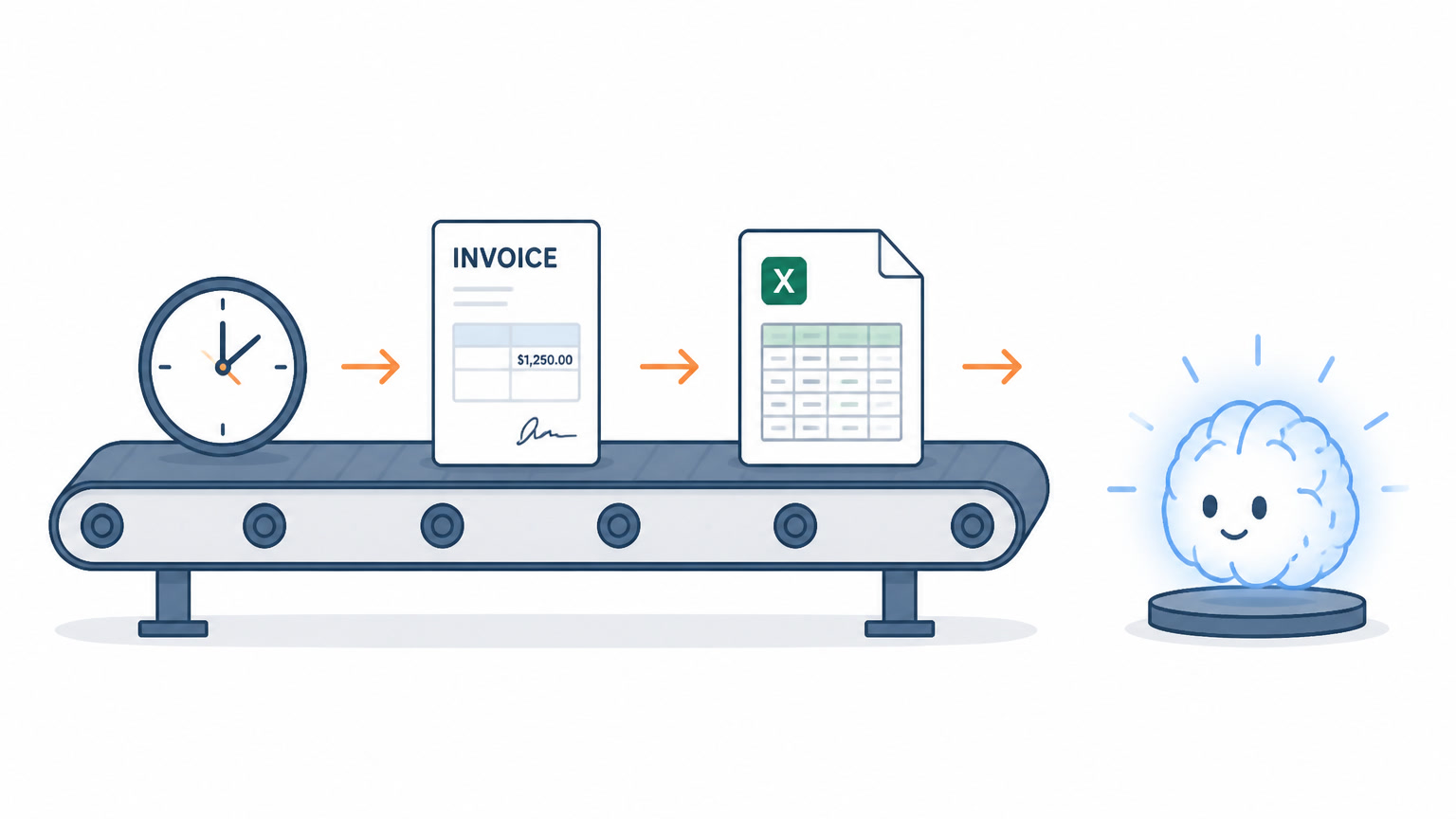
An automation is boring when it has four properties:
- Predictable input — the data entering the flow always has the same shape (an email with an invoice number, an appointment confirmation, a CRM field)
- Repeatable steps — the action sequence doesn't change between runs
- Known output — you know exactly what comes out (an email sent, a task created, a record updated)
- Visible pain — someone on your team does this manually every day and hates it
That combination is the formula for high ROI. According to data compiled by HeyNeuron and AutomationAtlas in 2026, the highest-return automations are the simplest ones:
| Automation | Year-1 ROI | Payback | Minimum Volume |
|---|---|---|---|
| Appointment reminders | 400-1,000% | 1-3 months | 50+/month |
| Email sequences | 500-2,100% | 1-3 months | 200+ subscribers |
| Invoice follow-up | 300-600% | 2-5 months | 30+ invoices/month |
| Report generation | 300-800% | 1-4 months | Weekly reports |
| Social scheduling | 150-400% | 2-6 months | 3+ active channels |
None of these require artificial intelligence. All are deterministic automations: if X, then Y. And precisely because of that, they work — no interpretation, no hallucination, no "the chatbot said something weird to the customer."
The excitement trap
89% of US small businesses now use AI in some capacity, per the US Chamber of Commerce 2026. But only 46% use it in actual operations (Federal Reserve, April 2026). That gap between adoption and production is exactly the trap: companies buy AI tools, pilot them, and never scale to production.
Why? Because AI introduces three variables that simple automations don't have:
- Output variability — a chatbot can give the same answer three different ways, or an incorrect one
- Continuous maintenance — the knowledge base updates, prompts get adjusted, models change
- Growing cost — every AI interaction carries a per-token cost that scales with volume
A deterministic automation has none of these problems. A flow that sends appointment reminders 48 hours before, generates a weekly sales report, or creates a CRM task when a lead changes stage — that flow works the same on day 1 as on day 365.
The boring automation audit: 4 steps to find your highest-ROI automations
Step 1: Map your team's repetitive tasks
Ask your team to list everything they do more than 5 times per week. Don't look for "automation" — look for tedium. The most boring tasks are usually:
- Copying data from an email into a CRM
- Sending appointment reminders via WhatsApp or email
- Generating sales or billing reports
- Following up on unpaid invoices
- Updating project statuses in management tools
Step 2: Classify by predictability
For each task, answer: Is the input always the same? Are the steps always the same? Is the output predictable?
| Category | Input | Steps | Output | Action |
|---|---|---|---|---|
| Deterministic | Always the same | Always the same | Always predictable | Automate now |
| Semi-structured | Variable but predictable | Mostly the same | Clear rules | Automate with validation |
| Unstructured | Free text, images | Requires interpretation | Variable | AI (with supervision) |
80% of a small business's tasks fall into "Deterministic" or "Semi-structured." Automate those first.
Step 3: Calculate the manual labor cost
Multiply: (minutes per execution) × (times per week) × (weeks per year) × (cost per hour of the employee).
Example: an office manager who spends 15 minutes daily sending appointment reminders:
- 15 min × 5 days × 50 weeks = 62.5 hours/year
- At $25 USD/hour = $1,562 USD/year in repetitive work
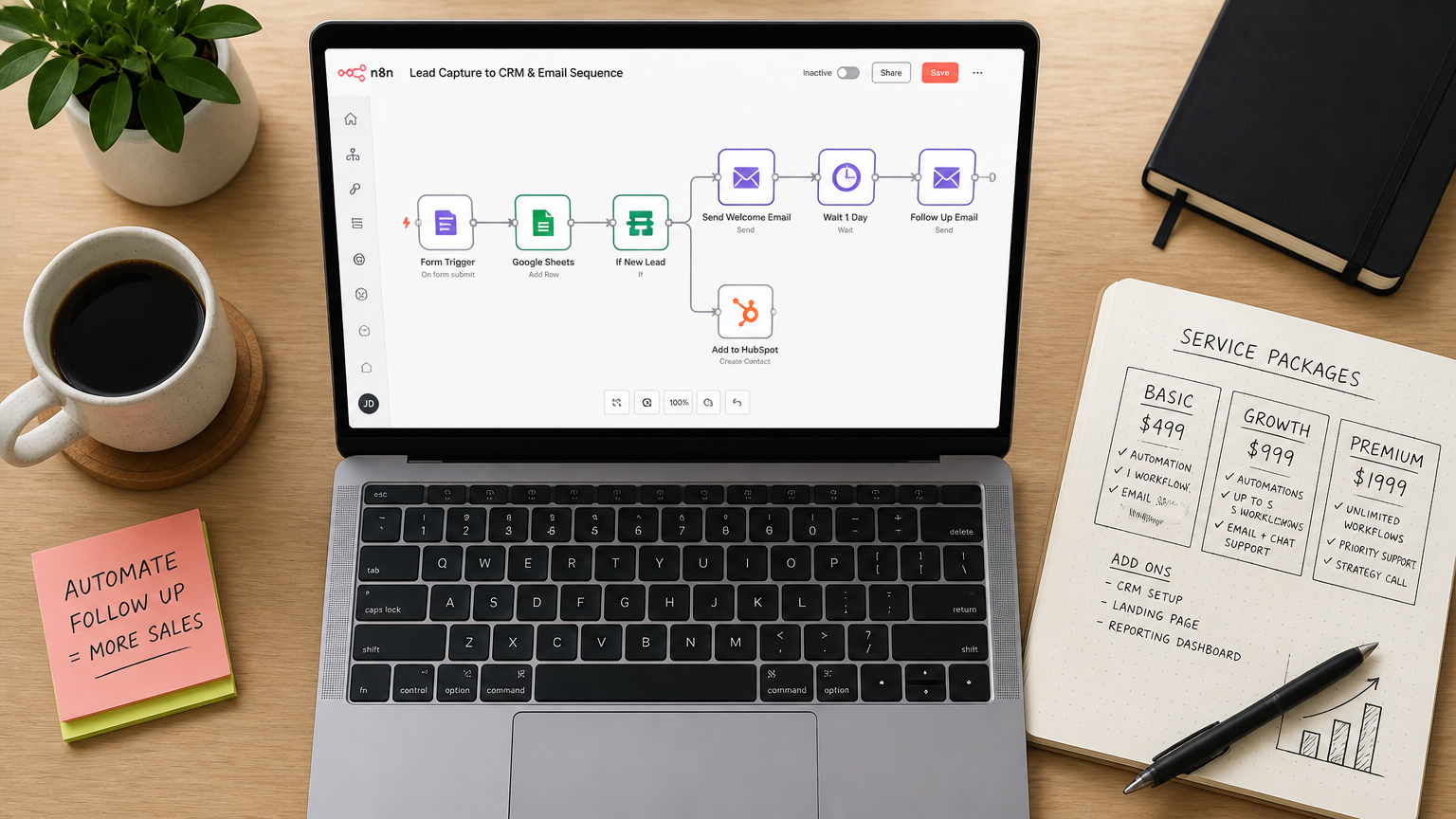
An n8n automation resolves this for $6-20 USD/month. The ROI is immediate.
Step 4: Implement in descending ROI order
Start with the task that saves the most hours with the lowest technical complexity. Don't try to automate everything at once.
The 4 boring workflows you should automate first
1. Appointment reminders (ROI: 400-1,000%)
What it does: 48 hours before an appointment, sends a reminder via WhatsApp or email with date, time, location, and an option to confirm or reschedule.
Why it works: Reduces no-shows by 30-45% (Conferbot, 2026). Every recovered appointment is direct revenue.
Stack: n8n + Google Calendar API + WhatsApp API (or email). Cost: $6-30 USD/month.
Implementation: An n8n flow that queries the calendar hourly, filters appointments within the next 48 hours, and sends the reminder. Initial setup: 2-4 hours.
2. Invoice follow-up (ROI: 300-600%)
What it does: When an invoice is due, waits 3 days. If no payment, sends a follow-up email. At 7 days, sends a second reminder with a payment link. At 15 days, notifies the team.
Why it works: 48% of salespeople never make a second contact (Thunderbit, 2026). Unpaid invoices are the most preventable cash flow problem in small businesses.
Stack: n8n + invoicing system (API) + email. Cost: $6-25 USD/month.
Implementation: Webhook from invoicing system → n8n checks status → email sequence with pauses → escalation to human. 3-5 hours of setup.
3. Automated reports (ROI: 300-800%)
What it does: Every Monday at 8am, generates a consolidated report of sales, incoming leads, pipeline, and pending tasks. Sends it via email or publishes it to Slack.
Why it works: A manager spending 2 hours weekly building reports loses 100 hours per year. Automation reduces that to zero.
Stack: n8n + Google Sheets/CRM + email/Slack. Cost: $6-20 USD/month.
Implementation: Query CRM and tool APIs → consolidate data → format → send. 4-6 hours of initial setup, then zero maintenance.
4. Automatic lead assignment (ROI: 200-500%)
What it does: When a lead arrives via form or WhatsApp, classifies it by service type, assigns it to the right salesperson, and sends a notification with context.
Why it works: Response time matters more than lead quality. Responding in under 5 minutes increases conversion 21x versus 30 minutes (Artemis GTM, 2026). Manual assignment adds 15-60 minutes of delay.
Stack: n8n + CRM + WhatsApp API. Cost: $20-50 USD/month.
Implementation: Form webhook → rule-based classification → CRM write → salesperson notification. 5-8 hours of setup.
The boring stack vs the exciting stack: cost comparison
| Aspect | Boring stack (deterministic) | Exciting stack (AI) |
|---|---|---|
| Monthly cost | $6-50 USD | $150-400 USD |
| Implementation time | 2-8 hours | 2-6 weeks |
| Error rate | <0.5% | 3-12% |
| Monthly maintenance | 30-60 minutes | 2-10 hours |
| Year-1 ROI | 300-2,100% | 100-400% |
| Payback speed | 1-5 months | 6-18 months |
The left column solves 80% of a small business's operational problems. The right column is only necessary when the input is free language or requires contextual interpretation.
When you DO need AI (and when you don't)
We're not saying AI has no value. We're saying sequence matters.
Automate first (deterministic):
- Reminders and confirmations
- Invoice follow-up
- Consolidated reports
- Rule-based lead assignment
- CRM status updates
- Deadline notifications
Add AI after (when the boring stack already works):
- Lead qualification from free text
- Intent classification in conversations
- Personalized content generation
- Sentiment analysis in support
- Early churn detection
Mintec's rule: if 80% of cases are resolved with rules, automate with rules. Use AI only for the 20% that requires interpretation.
The error we see in every implementation
At Mintec, the #1 error is the one HeyNeuron describes: companies start with the most exciting automation instead of the most profitable one. They buy an AI chatbot for the website, spend 3 months configuring it, and meanwhile the team is still manually copying email data into the CRM.
The winning pattern is reversed: automate the boring stuff first. When the team no longer spends hours on repetitive tasks, they have time to implement and maintain the AI tools that actually need natural language.
A company that automates reminders, invoices, and reports frees 100-200 hours per year per employee. Those hours get reinvested in closing deals, serving customers, and building the AI workflows that genuinely require language understanding.
Conclusion
The highest-ROI automation in your business is the one nobody wants to do manually. It doesn't need AI. It doesn't need a chatbot. It needs a predictable flow, a known input, and a tool like n8n or Make that executes without failing.
The data confirms it: appointment reminders (400-1,000% ROI), automated email (500-2,100% ROI), invoice follow-up (300-600% ROI). All deterministic. All AI-free. All with payback under 5 months.
Start with the boring. When that works, AI will have a solid stack to build on.
Sources: HeyNeuron / AutomationAtlas 2026 (ROI benchmarks by automation type); Thryv 2026 Small Business AI Report (70% revenue increase, 83% time savings); US Chamber of Commerce 2026 (89% adoption, 46% core operations); Federal Reserve April 2026 (46% core operations); Artemis GTM 2026 (speed to lead conversion data); Thunderbit 2026 (follow-up statistics); Conferbot 2026 (no-show reduction data).
Related articles:
- Low-code automation for SMBs in Latin America — real cost comparison of Zapier vs Make vs n8n
- When NOT to use AI for business automation — the 3-question decision framework
- CRM automation with n8n: 3 processes we built for real clients — real architecture with documented errors
- The hidden cost of disconnected automation — why disconnected tools destroy ROI
Frequently Asked Questions
What automation has the highest ROI for small businesses?
According to 2026 data, automated appointment reminders generate 400-1,000% ROI with 1-3 month payback. Automated email sequences follow at 500-2,100% ROI, and invoice follow-up automation delivers 300-600% ROI. All are simple, deterministic automations — no AI required.
Why do simple automations outperform AI chatbots?
Simple automations have predictable inputs, repeatable steps, and known outputs. AI chatbots handle natural language, introducing variability and error potential. For most small businesses, deterministic automation resolves 80% of operational problems at a fraction of the cost.
How much does it cost to implement basic automations with n8n?
A self-hosted n8n instance costs $6-20 USD per month. Three basic workflows (reminders, invoice follow-up, reports) processing 2,000-5,000 monthly operations cost $30-70 USD including server. That's 5-10x cheaper than equivalent Zapier enterprise plans.