
How to Measure GEO: 4 Metrics Google's Official Guide Left Out
Google's AI optimization guide tells you what to do but barely mentions how to measure results. These 4 metrics are what we actually use with clients to know if GEO is working.
How to Measure GEO: 4 Metrics Google's Official Guide Left Out
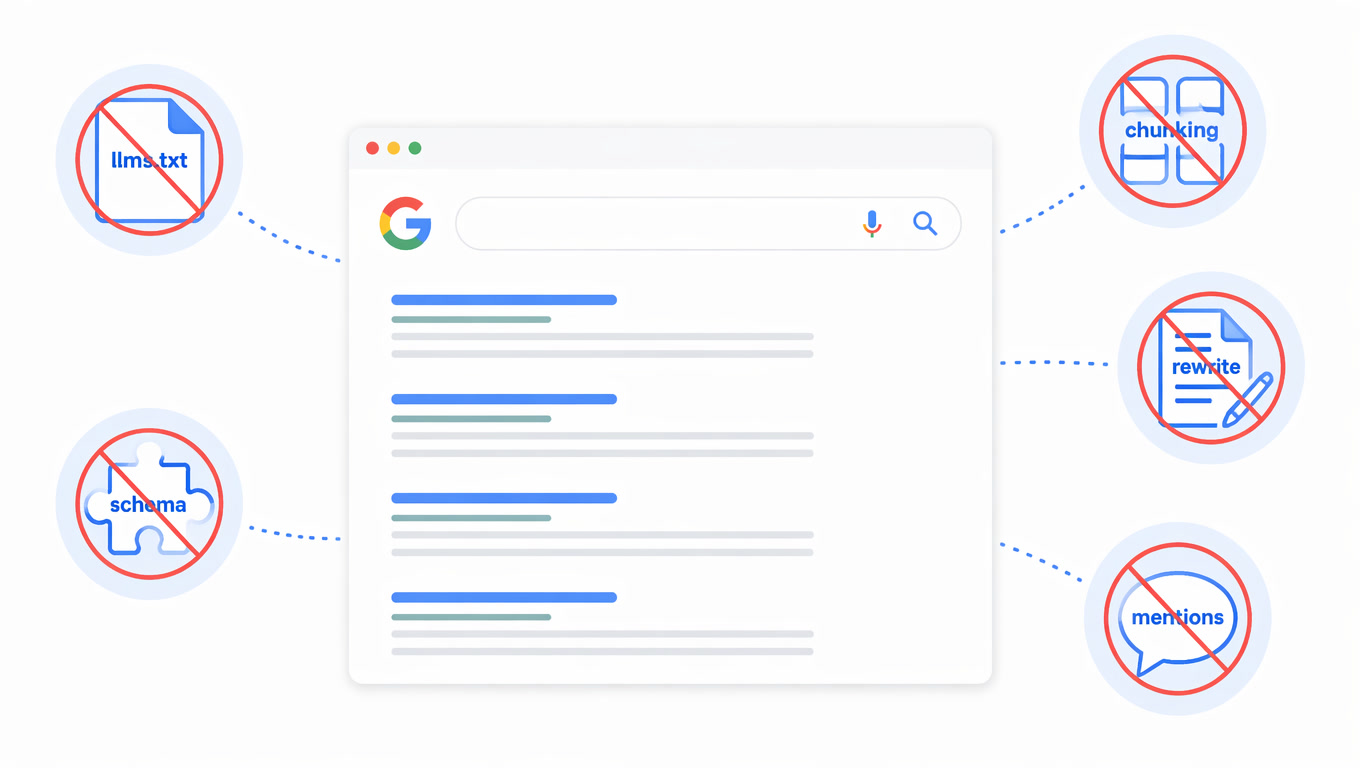
Google's official guide to optimizing for AI search, published in May and updated in July, settled one debate: GEO is not a separate discipline from SEO. It is SEO applied to a new distribution format. Fine.
But the guide has a truck-sized hole: it barely says anything about how to measure whether any of this is working.
It tells you "optimize for generative search" but not: "how do you know you got there?" What number do you look at? How often? What is "good"?
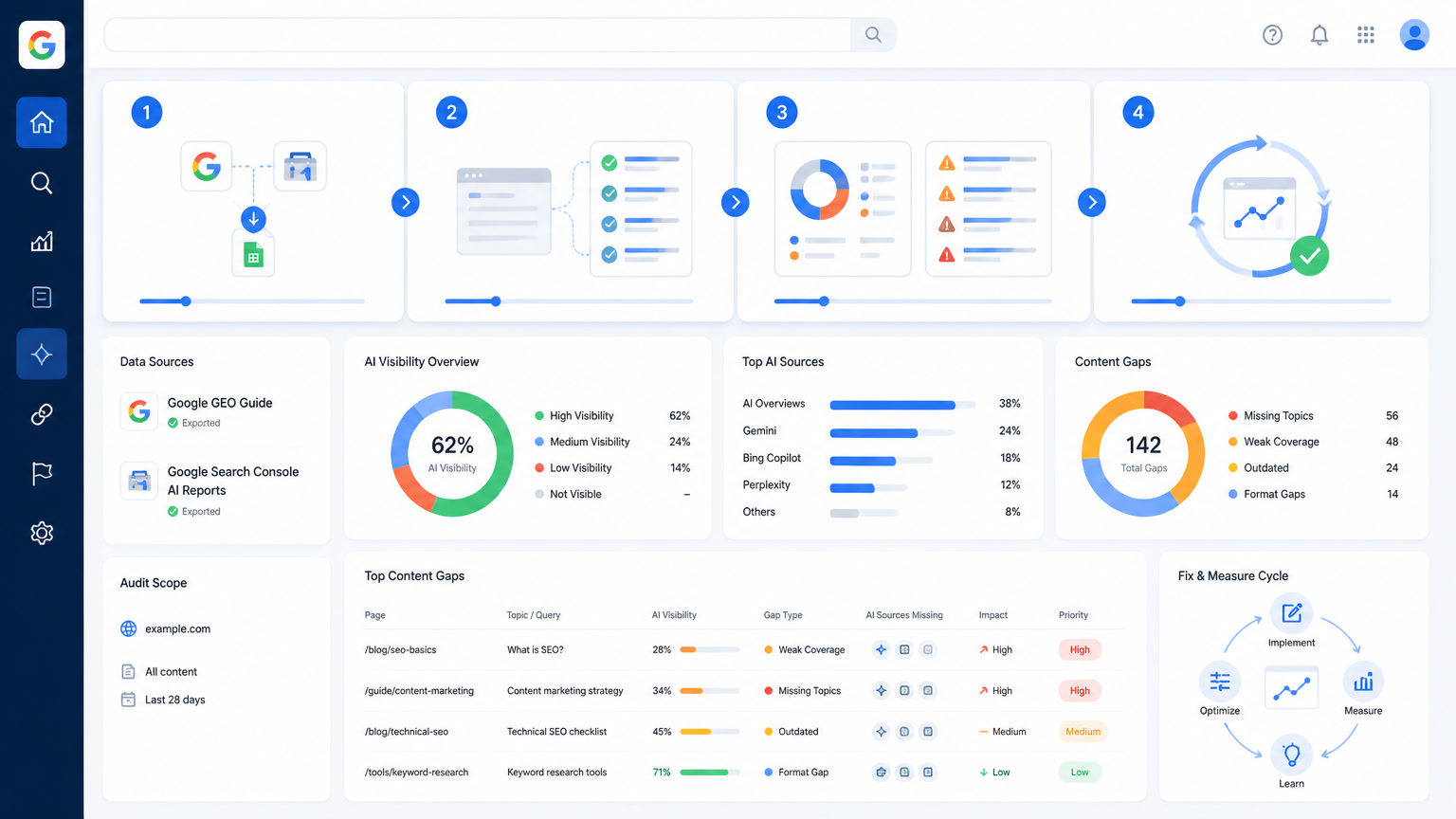
We have been measuring GEO for clients for months and building our own dashboards because the tools selling "GEO visibility scores" are, for the most part, smoke. Here is what actually works.
The problem with GEO dashboards for sale
Before getting to the metrics, a warning. If someone tries to sell you a "GEO Score" or "AI Visibility Index" as a magic number from 0 to 100, ask them how they calculate it. The answer is usually some variation of "we scan N AI sources for your brand name and count how many times you show up."
That is not measurement. It is a counter. And like any counter, it is easy to inflate and hard to interpret.
Google does not expose an "AI citation endpoint." There is no API that tells you which AI Overviews you appear in. The tools selling this are, at best, doing approximate scraping. At worst, they are making numbers up.
The metrics that actually matter are more specific and, honestly, harder to measure. But they are also a lot more useful.
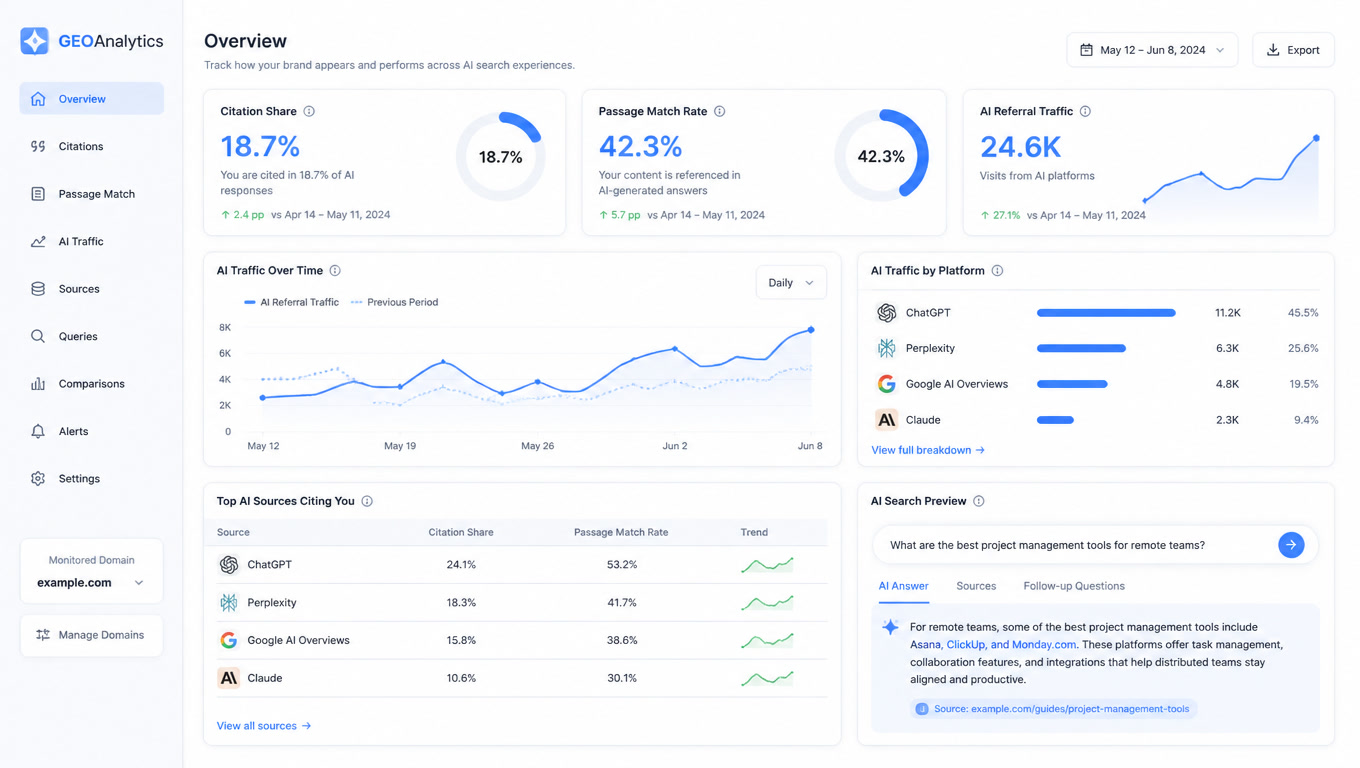
1. Citation Share
This is the most obvious metric and the one everyone talks about, but almost nobody defines it well.
Citation Share is the percentage of AI-generated answers within a specific topic cluster that cite your content. Not "how many times your brand showed up in ChatGPT." It's: out of every AI answer to a question in your topic area, how many mention you?
You measure it by defining your cluster (something like "AI Overviews optimization for ecommerce sites" — specific enough to be meaningful), building a list of 20-30 questions your audience asks about that topic, and querying each one across AI Overviews, ChatGPT, Perplexity, and Gemini. Then count how many answers cite you vs. your competitors. Citation Share = your citations / total citations in the cluster.
This sounds tedious because it is. But a sample of 20-30 queries per cluster, run once a month, gives you real data. The alternative is paying for an "AI Visibility Score" that you cannot verify.
What is a good number? Depends on the cluster. In low-competition niches, 15-20% is solid. In saturated ones, 5-8% is respectable. The number matters less than the month-over-month trend.
2. Passage Match Rate
Google confirmed in its guide that AI Mode uses query fan-out: it breaks a user query into 10-15 sub-queries and hunts for specific passages that answer each one.
Passage Match Rate measures how many of your key passages correspond to real sub-queries that AI Mode generates through its query fan-out mechanism. Most sites I've checked land between 10% and 30%. Above 50% is where citations start getting consistent.
To measure it, pick 5-10 pages with the highest citation potential (check Search Console for pages with AI Overviews impressions but few clicks). Extract the main passage from each — the first 150-200 characters after each H2. Then ask yourself for every passage: "What specific question does this answer as a standalone piece of text?"
Now Google your main topic and look at the "People also ask" section. Those are real sub-queries. Match your passages against them. Passage Match Rate = passages that hit a sub-query / total passages analyzed.
This exercise is manual, but it is the highest-value thing you can do. When a passage and a sub-query match, citations follow. When they do not, you can spend months tweaking schema and nothing happens.
3. AI Mode Incremental Traffic
This is my favorite one because it connects to dollars.
AI Mode Incremental Traffic is the clicks from AI Overviews or AI Mode that land on pages outside the organic top 10. Why does this matter? Because 68% of pages cited in AI Mode sit outside the top 10. GEO is not stealing traffic you already had — it is giving you traffic that did not exist before.
Go to Search Console, filter by "Search type: AI Overview" (this showed up in June 2026). Export the URLs getting clicks. Cross-reference with your traditional rankings. Any URL getting AI clicks but sitting outside the organic top 10 counts as incremental. Sum those clicks. That is your real GEO value.
For editorial sites with deep content libraries, this number can be huge. On one site we measured, 41% of AI Mode traffic was incremental — pages nobody was finding through traditional search but that happened to answer exactly the right sub-query.
4. Citation Half-Life
This one nobody talks about. Might be the most important for planning.
Citation Half-Life is the time it takes for half of your AI citations to be replaced by fresher content. Content in AI Overviews and ChatGPT has an expiration date. Unlike traditional SEO, where a solid article can rank for years, AI citations cycle toward fresher content constantly. We do not have exact numbers because the data is limited, but our empirical observation suggests a half-life of 3 to 6 weeks in AI Overviews.
Pick 3-5 URLs currently being cited. Note the date. Re-query the same question weekly. When half your URLs stop getting cited, that is your half-life. Repeat across different clusters to find variations.
Manual, yes. But it tells you something no dashboard will: how often you need to refresh content to maintain citations. If your half-life is 3 weeks, updating every 6 months is pointless.
Put it all together
Start with Citation Share and Incremental Traffic. Those two give you the clearest signal with the least manual effort. Add Passage Match Rate once those are running. Citation Half-Life is for when you are ready to get obsessive.
The temptation is to outsource this to a tool that spits out a pretty number. But the tools do not exist yet. Google does not expose passage-level citation data. AI platforms do not have analytics APIs. Until that changes, GEO measurement is handcraft work.
Honestly, I think that is an advantage. Teams that understand these metrics from the inside will be way ahead when the automated tools finally arrive. Because they will know what questions to ask. The people buying dashboards with "AI Visibility Scores" right now are not learning anything. They are paying for reassurance.
Sources: Google Search Central — AI Optimization Guide (2026), iPullRank — AI Mode citation study (2026), Mintec internal data from GEO client campaigns (March-July 2026).
Frequently Asked Questions
How do you measure GEO (Generative Engine Optimization) performance?
GEO performance is measured with metrics like Citation Share (what percentage of AI answers in your niche cite your content), Passage Match Rate (how many of your key passages match real AI Mode sub-queries), AI Mode Incremental Traffic (clicks from AI Overviews to pages outside the organic top 10), and Citation Half-Life (how long your content remains citeable before being replaced by fresher sources).
Can Google Search Console measure GEO performance?
Yes. Google's AI Performance reports in Search Console (launched June 2026) show impressions and clicks from AI Overviews and AI Mode. The limitation is they don't show which specific passages were cited or which query fan-out sub-queries triggered your appearance.
What is the difference between traditional SEO metrics and GEO metrics?
Traditional SEO measures page rankings, impressions, and CTR in blue-link results. GEO measures passage-level citation, sub-query coverage within topic clusters, and traffic from conversational interfaces where there is no 'position 1' — only binary inclusion or exclusion.