
AI Prompts vs Rules-Based Lead Scoring: The Hybrid Framework That Actually Works
AI prompts promise to revolutionize lead qualification. The reality is more nuanced. Here's when prompts actually outperform traditional rules, when they don't, and how to combine both for maximum conversion.
AI Prompts vs Rules-Based Lead Scoring: The Hybrid Framework That Actually Works
If you've searched for "AI prompts for lead generation" recently, you've seen hundreds of articles promising a well-crafted prompt will transform your sales pipeline. The reality — as usual — is more nuanced.
A few weeks ago, Sol Rashidi — Chief Strategy Officer at Cyera and a senior fellow at Harvard Kennedy School — fired half her AI agents. Her reason: she was spending more time supervising them than doing useful work. Glean's Work AI Index 2026 backs up her experience: after surveying 6,000 workers, it found 36% of AI sessions fail outright, and white-collar workers spend an average of 6.4 hours per week on what it calls "botsitting" — correcting errors, re-feeding context, and debugging mediocre outputs.
This doesn't mean AI is useless for lead qualification. It means we're applying AI where traditional rules work better, and rules where AI would be more effective.
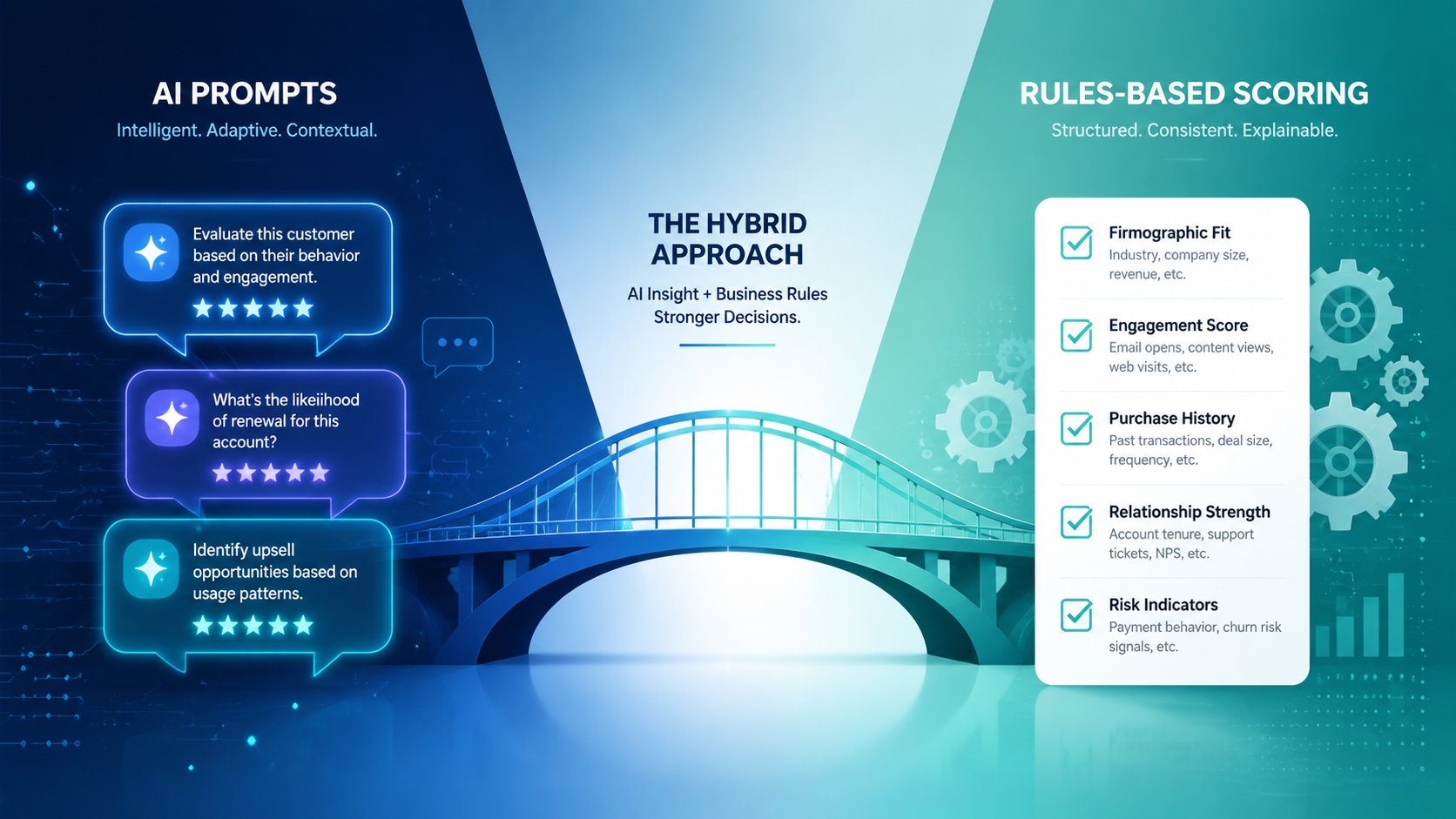
Here's the hybrid framework we use at Mintec to decide when to use AI prompts, when to stick with traditional rules, and when to combine both.
The Core Problem: Not Everything Needs AI
The AI agent boom has created implicit pressure: "if you're not using AI, you're falling behind." A Reddit thread with 54 upvotes and 27 comments on r/automation put it well: "I feel like people keep force-using AI for things that can be done with regular automation and end up reinventing the wheel with a few screws loose."
In lead qualification, this translates to teams implementing complex GPT prompts to decide if a lead is qualified — when a three-line rule in their CRM would do the job just as well.
The problem isn't AI. It's when and how we apply it.
The Three Conditions for AI Prompts to Actually Work
Based on our experience implementing qualification systems for B2B clients across Latin America, AI prompts only outperform traditional rules when three conditions are met:
1. Clean, Complete CRM Data
Coffee.ai found that ML-based lead scoring improves accuracy by up to 60% vs rules-based systems — but only when the CRM supplies clean data. A LinkedIn poll by Raman Arora showed 56% of professionals cite data quality as the #1 obstacle to making AI work in CRM.
If your CRM has empty fields, duplicates, or outdated records, AI prompts will amplify that problem, not solve it. AI isn't magic: garbage in, garbage out — just faster and better-worded.
2. Enough Volume for AI to Learn
Rules work with 10 leads. AI needs hundreds to be more accurate than a well-designed rule. In our experience, the inflection point is around 500 qualified leads per month. Below that, a simple BANT or GPCT rule well-implemented delivers the same result with far less complexity.
3. A Clear, Documented ICP
This is the one that hurts most. I've seen teams spend weeks optimizing AI prompts for lead qualification without having a documented Ideal Customer Profile (ICP). If you can't define on paper what makes a lead good, no prompt will discover it for you.
AI can find patterns you don't see. It can't invent criteria that don't exist.
The Hybrid Decision Framework
When all three conditions are met, here's the hybrid approach that works best:
| Scenario | What Works | Why |
|---|---|---|
| Low volume (<100 leads/mo) | Traditional rules (BANT, GPCT) | AI doesn't have enough data to outperform a rule. |
| Medium volume (100-500 leads/mo) | Rules + AI for edge cases | Use rules for 80% obvious cases; AI for borderline leads. |
| High volume (500+ leads/mo) + clean data | AI with human supervision | AI scales, but needs periodic accuracy reviews. |
| Complex ICP (10+ variables) | AI with exclusion rules | AI captures nuance; rules filter what's never a fit. |
| Regulated industry | Rules + human review | AI can't make decisions requiring legal judgment. |
| Limited budget | Rules + manual enrichment | Investing in data enrichment delivers better ROI than AI prompts. |
How to Implement It in Your CRM
The framework translates into a three-layer architecture we've implemented with Clientify, n8n, and OpenAI APIs:
Layer 1: Exclusion Rules (Always)
This doesn't need AI. In your CRM (we use Clientify), set up rules to:
- Discard leads that don't meet minimum criteria (wrong industry, out of coverage area, budget too low)
- Assign leads that clearly meet criteria directly to a rep
- Enrich leads with missing data before passing to qualification
Layer 2: AI Prompts for Edge Cases
For leads that pass exclusion rules but aren't obvious, a structured prompt helps. The secret is in the prompt structure, not the model:
You are a B2B lead qualifier. Analyze this prospect on:
1. ICP Fit (0-10): does it match [industry, size, role]?
2. Purchase Intent (0-10): are there active need signals?
3. Timing (0-10): does the lead have budget and a defined timeline?

Lead: {lead data}
Composite Score: (fit × 0.5) + (intent × 0.3) + (timing × 0.2)
Recommendation: Qualified / Not qualified / Needs manual review
The difference from a traditional rule is that the prompt evaluates context and nuance — not just whether the title contains "Director" or the industry is "Technology."
Layer 3: Continuous Monitoring and Adjustment
The #1 mistake we see is implementing AI prompts without measuring accuracy. Without a feedback loop, you don't know if AI is improving or degrading your qualification.
Each week, review:
- How many AI-qualified leads actually converted?
- How many AI-discarded leads turned out to be missed opportunities?
- Is AI accuracy higher than your current rules?
Why the Hybrid Approach Works in LatAm
In Latin America, the tool stack has specific characteristics. All-in-one platforms like HubSpot Enterprise ($1,200+/mo) are prohibitive for most local businesses. A modular stack with Clientify as CRM, self-hosted n8n for orchestration, and OpenAI APIs for prompts costs between $70 and $200 per month — and offers more flexibility.
The modular advantage is that you can start with just rules (Layer 1), and add Layers 2 and 3 when volume justifies it. You don't need to commit to AI from day one.
The Over-Automation Risk
Back to Sol Rashidi: "Leaders are going to have to get past the narrative of 'we must do AI at all costs' because sometimes the cost is higher than the reward."
In lead qualification, the cost of over-automation isn't just monetary — it's the opportunity cost of misqualified leads, sales reps chasing cold prospects, and teams losing trust in the system.
A study on AI lead scoring for B2B showed that well-implemented predictive models should produce at least a 3x difference in conversion rate between top-scored and bottom-scored leads. If your system isn't producing that separation, the problem isn't the technology — it's how you're applying it.
Conclusion: Rules for the Obvious, AI for the Nuance
AI-powered lead qualification isn't a replacement for traditional rules. It's a complement for when rules fall short.
The hybrid framework that works:
- Start with rules — define your ICP, set up exclusion rules and basic scoring in your CRM
- Add enrichment — before thinking about prompts, make sure your CRM data is complete. CRM enrichment automation is the necessary prerequisite
- Introduce AI gradually — start with edge cases, then scale
- Measure everything — without metrics, you don't know if AI is helping or hurting
If you want to go deeper on building a complete lead qualification strategy, check out our article on the lead nurture automation maturity framework, which covers how to scale from basic rules to AI-powered multi-channel orchestration.
AI for lead qualification isn't overrated. But it's not the silver bullet many make it out to be. It's one more tool in your stack — powerful when used where it belongs, noise when forced where it doesn't.
Frequently Asked Questions
What's the difference between AI prompt-based lead scoring and traditional rules-based scoring?
Rules-based scoring assigns points based on fixed conditions (job title, industry, company size). AI prompt-based scoring uses natural language prompts to analyze prospects contextually, catching nuances rigid rules miss. AI is more flexible but requires clean CRM data and a well-defined ICP.
When should a business use AI prompts instead of rules for lead qualification?
Use AI prompts when you handle over 500 leads per month, your ICP is complex (multiple interrelated variables), and your CRM has clean conversion history data. Use rules when your volume is low, your qualification criteria is binary, or your team doesn't have access to AI APIs.
What's the most common mistake when implementing AI prompts for lead scoring?
Assuming AI prompts can compensate for dirty data or a poorly defined ICP. Without clean, enriched CRM data, AI scales the problem rather than solving it. The second mistake is not measuring — if you're not comparing AI accuracy against your existing rules, you have no idea if you're improving or degrading qualification quality.