
Behavioral email segmentation in B2B: the maturity curve most teams skip
Behavioral segmentation converts 4-6x better than batch sends. Here's the 5-level maturity curve and how to implement it without an enterprise budget.
Behavioral email segmentation isn't an advanced tactic — it's the baseline that separates B2B programs generating real pipeline from ones just filling inboxes. DMA data (2026) shows segmented campaigns produce 760% more revenue than non-segmented ones. But the number nobody discusses is how you segment: demographic segmentation (industry, title, company size) delivers 1.5-2x lift, while behavioral segmentation (what the contact actually did recently) delivers 2.5-3.5x, and predictive segmentation reaches 4-6x according to Verified.email.
The difference isn't subtle. And in B2B, where each qualified lead is worth hundreds or thousands of dollars, ignoring this maturity curve leaves money on the table every single week.
The segmentation maturity curve: 5 levels
Verified.email published a segmentation maturity curve in 2025 that synthesizes years of accumulated industry data. We've reformulated it for the SMB context, where most teams start at Level 0 and Level 2 is where the bulk of ROI lives:
| Level | Approach | Typical Result | Implementation Effort |
|---|---|---|---|
| 0. Batch-and-Blast | Same email to everyone | Open: 25-30%, CTR: 1-1.5% | None (the default) |
| 1. Demographic | By industry, size, title | Open: +10-15%, CTR: +20-30% | Low (CRM fields) |
| 2. Behavioral | By engagement tier, content consumed | Open: +25-30%, CTR: +50-70% | Medium (tracking in ESP/CRM) |
| 3. Lifecycle | By funnel stage, buying moment | Open: +30-40%, CTR: +80-120% | Medium-high (lead scoring) |
| 4. Predictive | By propensity, intent signals, AI scoring | Open: +40-60%, CTR: +150-200% | High (ML/data science) |
| 5. Account-Based | Individual persona + company context + stage | Open: +60-100%, CTR: +200-400% | Very high (full orchestration) |
Most B2B teams in SMB contexts are stuck at Level 0 or 1. And the biggest ROI jump doesn't come from going from 1 to 5 — it comes from going from 1 to 2. Behavioral segmentation is where the curve accelerates.
Why demographic segmentation isn't enough
A VP of Marketing at a SaaS company in Austin and a Director of Operations in Chicago can share the same title and industry but be in completely different moments of the buyer journey. One is researching solutions (top of funnel); the other has already compared pricing and needs an argument to approve the budget (bottom of funnel).
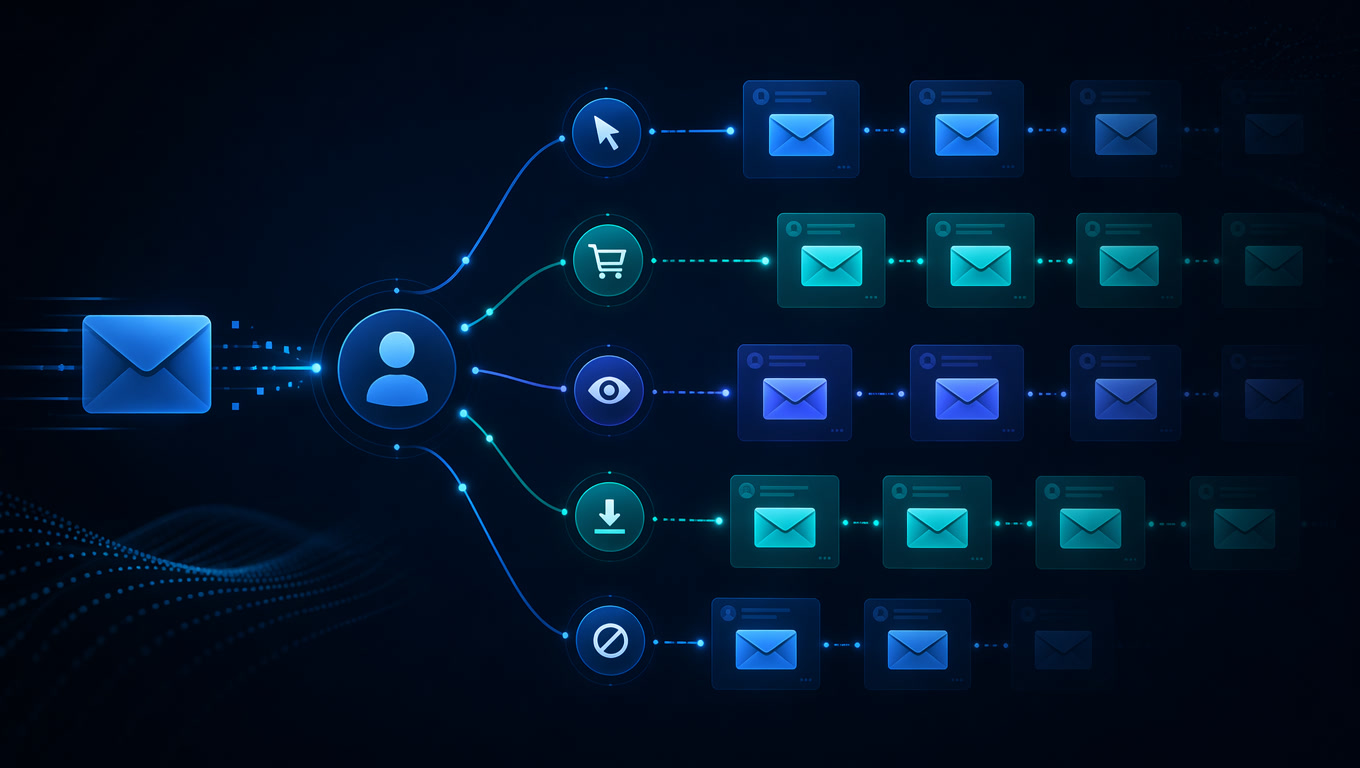
If you send them the same email because they're both "VP Marketing in SaaS," you're wasting critical context. Behavioral segmentation captures this moment: Did they open the ROI email? They're evaluating. Did they visit the pricing page? They're ready for a demo. Have they gone silent for 30 days? They need re-engagement, not more content.
TofuHQ (2026) reports personalized B2B emails achieve 26% higher opens and 41% higher CTR than generic sends. And nurture sequences using behavioral triggers — sending the next email based on prior engagement rather than fixed time delays — perform 15-20% above industry averages.
The 3 behavioral triggers that convert hardest in B2B
Not all behaviors are equal. Across our implementations with SMBs in the US and LatAm, these three triggers produce the highest conversion lift:
1. Pricing page revisited (high intent)
When someone comes back to your pricing page, they're no longer exploring — they're deciding. Response time matters here as much as it does with WhatsApp leads: InsideSales documented that leads waiting more than 5 minutes are 10x less likely to qualify.
Suggested automation: Detect visit → immediate internal notification + personalized email with an industry-specific case study + direct link to book a call. Stack: n8n webhook + Clientify + template.
2. Content downloaded (medium intent)
Someone who downloads a whitepaper or guide has already traded their email for information. But the quality of the follow-up determines whether that lead advances or goes cold. The most common mistake: sending the same "thanks for downloading" to everyone.
Suggested automation: Classify downloaded content by topic → trigger a 3-email sequence that deepens that specific topic → on the third email, offer a free assessment. Stack: n8n + Clientify scoring + email automation.
3. 30+ days inactive (re-engagement or sunset)
A lead who stopped interacting isn't necessarily dead. But continuing to send content without diagnosing why they disengaged wastes sends and damages sender reputation.
Suggested automation: Detect inactivity → re-engagement email with a direct question ("Are you still looking for solutions to X?") → if no reply in 7 days, move to low-frequency list → if they reply, re-classify and activate personalized nurtures.
The mistake we see in every implementation
The number one mistake isn't the tool or the strategy — it's trying to do too much from day one. We saw this with a consulting client in Mexico City that wanted to launch 12 behavioral segments simultaneously without behavior tracking configured in their CRM. The result: zero behavior data = zero real segments = batch-and-blast with a different name.
The correct implementation order:
- Weeks 1-2: Set up basic tracking (opens, clicks, pages visited) in your CRM. Clientify and HubSpot do this natively; with n8n you can build it via webhooks.
- Weeks 3-4: Create 3 basic behavioral segments: active (opened in last 14 days), cold (no opens in 30+ days), and engaged-but-not-converted (opened + clicked but didn't fill a form).
- Month 2: Add 2-3 high-intent triggers (pricing page, case study download, repeat visit).
- Month 3: Evaluate results, refine segments, consider a predictive layer with AI.
Modular stack vs enterprise platform
| Factor | Modular stack (n8n + Clientify + AI) | Enterprise platform (Marketo, Pardot) |
|---|---|---|
| Monthly cost | $30-150/mo | $500-2,000+/mo |
| Behavioral segmentation | Manual + API + webhooks | Native GUI |
| Predictive capability | Via n8n + OpenAI API ($20-50/mo extra) | Built-in (but requires historical data) |
| Learning curve | 1-2 weeks per tool | 2-4 months to leverage |
| Flexibility | Total (open source) | Limited to vendor roadmap |
| LatAm support | Community + local implementer | English-only support, US/EU hours |
For an SMB with 1,000-10,000 contacts, the modular stack delivers 80% of the functionality at 10-25% of the cost. Enterprise platforms justify their price when you have 50,000+ contacts, multiple markets, and a dedicated marketing ops team.
The next level: dynamic content by segment
Once behavioral segments are working, the next step is dynamic content — emails that change their content based on the recipient's profile and behavior. This isn't about personalizing "Hi {first_name}" (that's table stakes now); it's about adapting the entire value proposition.
Verified.email reports multi-variable dynamic content produces +35% engagement and +42% conversion vs static emails. In practice for B2B:
- Same email, different content blocks: A block of testimonials from the recipient's industry, a block of metrics relevant to their company size, and a CTA adapted to their funnel stage.
- Smart send-time by timezone: AI-optimized send-time produces 15-41% more opens. For teams operating across multiple timezones, this is real differentiation.
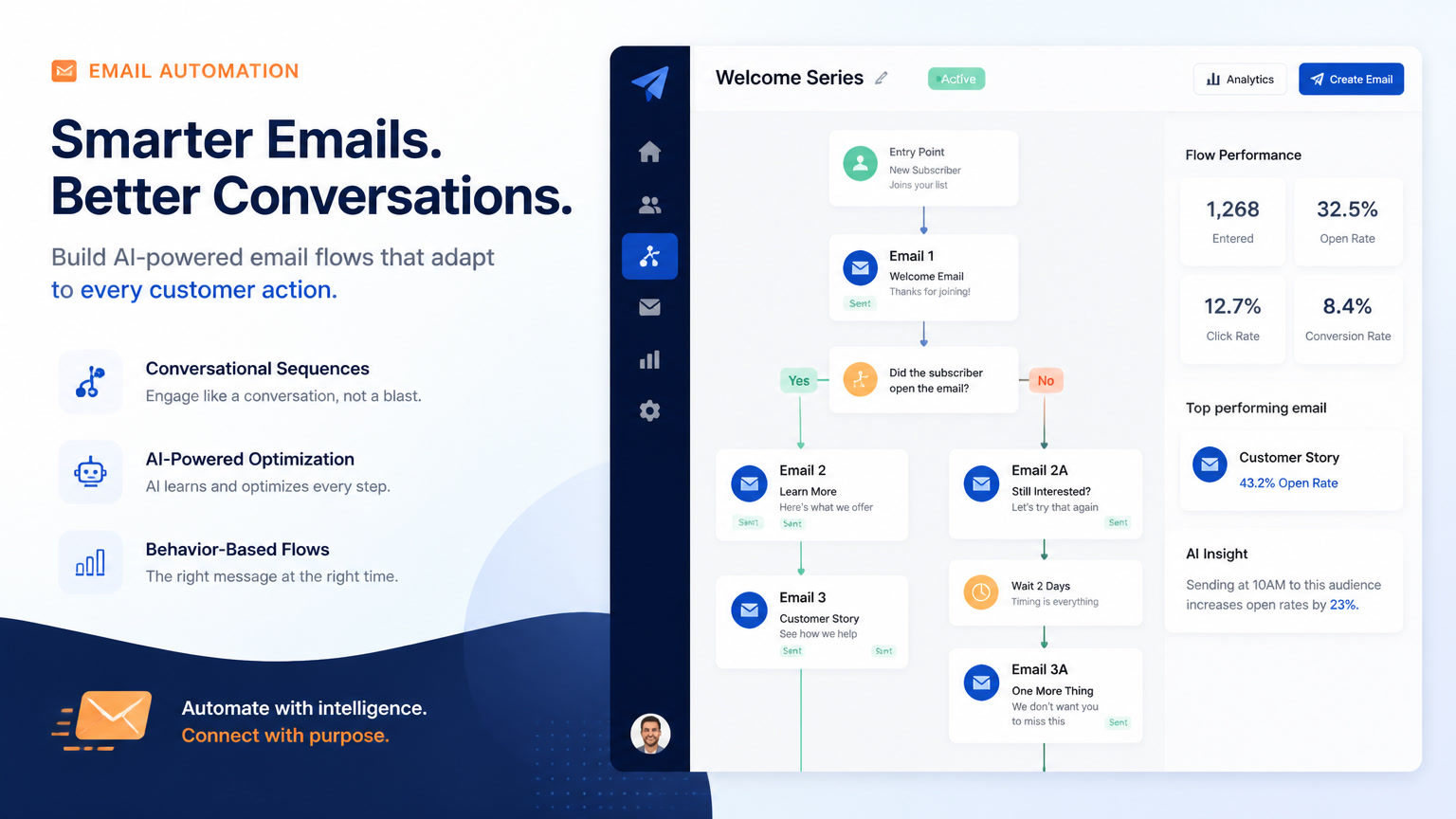
- Conditional branches: If the contact opened the previous email, send the next level of depth. If they didn't open, change the subject line angle and content tone.
Metrics that matter (and ones that don't)
Forget open rate as your primary KPI — since Apple Mail Privacy Protection affects 55-60% of opens, it's a deliverability proxy, not an engagement metric. Instead, measure:
| Metric | What It Measures | B2B Benchmark 2026 |
|---|---|---|
| CTR (Click-Through Rate) | Content relevance | 2.68% average, 4.12% top quartile |
| CTOR (Click-to-Open Rate) | Post-open quality | 7.84% average |
| Reply Rate | Engaging enough to respond | 0.92% average, 2.1% top quartile |
| Email-to-Meeting | Real pipeline conversion | 0.18% generic vs 0.47% personalized (+161%) |
The metric that matters most for B2B is email-to-meeting: the rate at which an opened email converts to a scheduled meeting. Personalized emails achieve 161% more email-to-meeting than generic ones (TofuHQ, 2026). That's what actually impacts pipeline.
The opinion nobody states plainly
Most email automation platforms sell "personalization" as a feature. But true personalization isn't in the tool — it's in the data architecture behind it. If your CRM doesn't have behavior tracking configured, if your team hasn't defined which actions are "intent signals," and if nobody owns the segments, no platform will save you.
Starting with behavioral segmentation doesn't require a $2,000/month platform. It requires defining 3 behaviors that matter, setting up tracking for them, and building 2 automated workflows that respond to those behaviors. Everything else is marginal optimization.
Sources and data
- DMA (2025/2026): segmented campaigns generate 760% more revenue than non-segmented
- Verified.email (2025): 5-level segmentation maturity curve with conversion lift per level
- TofuHQ (2026): B2B email benchmarks — personalized emails 26% more opens, 41% more CTR, 161% more email-to-meeting
- Cirrus Insight (2026): segmented lists produce 50% more CTR (up to 3.6%)
- InsideSales: leads waiting >5 minutes are 10x less likely to qualify
- InsideSales: B2B buying behavior — 30-50% of budget allocated in first 25% of cycle
Related articles
- Behavioral email automation for B2B — The 3-tier behavioral email trigger framework
- Lead nurture with automation — 4-level nurture maturity framework
- Lead scoring and clean data — Why segmentation without clean data doesn't work
- CRM process automation with n8n — CRM automation workflows for SMBs
Frequently Asked Questions
What is behavioral email segmentation in B2B?
Behavioral segmentation divides your email list based on actions contacts have already taken — opened an email, visited a pricing page, downloaded a resource — instead of relying solely on demographics like industry or job title. This enables sending the right content at the right moment, which produces 2.5-3.5x more conversions than batch-and-blast sending.
How long does it take to implement behavioral segmentation?
Level 1 (basic demographic segmentation by industry/role) takes 1-2 days with any CRM. Level 2 (behavioral) takes 1-2 weeks: you need behavior tracking in your CRM or email platform, at least 3-5 defined segments, and 2-3 automated workflows. Level 3 (predictive) requires 1-3 months of historical data to train scoring models.
What tools do I need to automate behavioral email segmentation?
For SMBs, a modular stack works best: Clientify or HubSpot for CRM, n8n or Make for workflow automation, and the OpenAI API for predictive scoring. Total cost: $30-150/mo vs $500-2,000/mo for enterprise platforms like Marketo or Salesforce Pardot.