
Fimo Turns AI-Generated Code Into Websites That Improve Themselves
Fimo, the autonomous website platform from the Strapi team, launched September 8, 2026. It takes code from Claude Code, Codex, or Cursor and wraps it with agents that run 24/7 on SEO, translations, and content refresh — each change landing in a branch you review. Here is what it actually changes for agencies and dev teams.
Fimo Turns AI-Generated Code Into Websites That Improve Themselves
The Strapi team just launched a product that changes what "website" means. Fimo, shipped September 8, 2026, takes code generated by Claude Code, Codex, Cursor, or any AI coding agent and wraps it with a headless CMS, a visual editor, and — here is the part that matters — autonomous agents that run around the clock to improve the site after launch. SEO content, internal links, schema fixes, translations, stale content refresh. Every change lands in a Git branch. A human reviews and merges. The website doesn't just exist; it compounds.
We have been building client sites on Strapi and Astro for two years. When the team that created Strapi launches a new product that redefines the category they pioneered, we pay attention. This is not another "AI website builder." It is a different architectural bet about what happens after you ship.
What Fimo actually is
Fimo sits between two things the market already understands: AI website generators (which create a site and stop) and headless CMS platforms (which manage content but don't improve it). Fimo's claim is that neither model matches how modern websites actually need to work.
The product works in three layers:
Layer 1 — Bring your AI code. You build or modify your site with whatever coding agent you already use. Claude Code, Codex, Cursor, Copilot. Fimo doesn't replace your tools; it takes their output and makes it editable and agent-ready. Pierre Burgy, Strapi's co-founder, frames it bluntly: "Coding agents changed who writes the code, but writing the code is only half the battle."
Layer 2 — Edit visually, ship from git. A visual CMS sits on top of the real code. Click anything, edit in real time, and the underlying code updates. Your repo stays the source of truth. No "export your site" — the code is always yours.
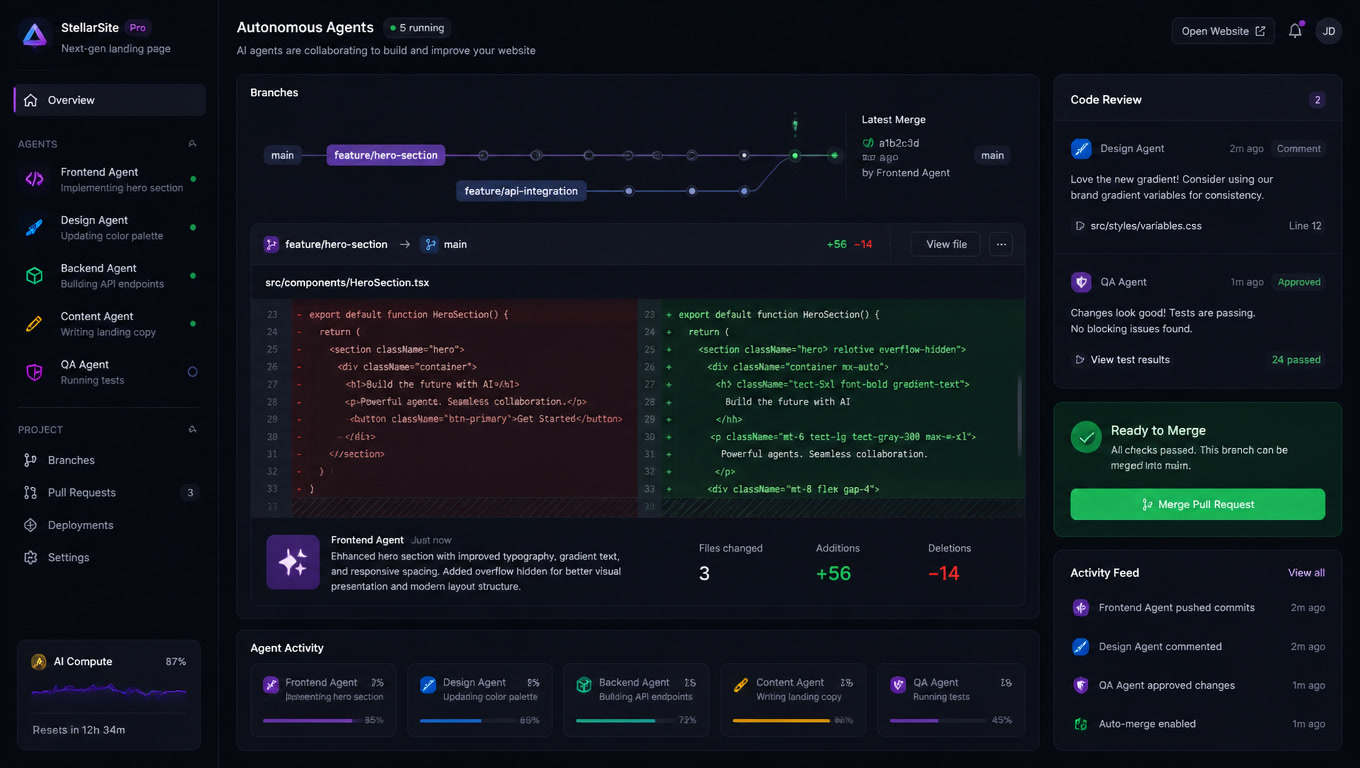
Layer 3 — Autonomous agents. This is where Fimo diverges from everything else. Agents run on schedules you set: an SEO agent audits every page and proposes fixes, a translation agent converts content into seven languages, a refresh agent updates stale pages, a linking agent builds internal links. Each run opens a branch, runs in an isolated environment (dedicated server, database, asset bucket), and waits for a human to review the diff before merging.
The "autonomous website" framing is the real story
Most CMS marketing talks about features. Fimo is selling a category: the autonomous website. The pitch is that websites shouldn't degrade after launch — they should get better. Content goes stale, schema breaks, competitors publish more, translations lag behind. The current model is "hire someone to fix it quarterly." Fimo's model is "agents fix it constantly, humans approve the fixes."
This is not a trivial reframing. In our experience running content pipelines for clients, the biggest bottleneck is not creating content — it is maintaining it. A 200-page multilingual site loses measurable organic traffic within 90 days if nobody is refreshing, linking, and updating structured data. The question Fimo answers is: what if the maintenance happened automatically, with the same quality gates a human team would use?
The answer is the branch model. Agents don't get a "publish" button. They get a "propose a change" workflow. This is the same pattern we enforce in our own agent-assisted publishing pipeline — scoped permissions, dedup gates, schema validation, and post-publish verification. Fimo bakes the first two layers into the product. You still own the approval step.
Comparison: where Fimo fits in the 2026 CMS landscape
| Dimension | AI Website Builders (Wix, Framer) | Traditional Headless CMS (Contentful, Strapi) | Fimo |
|---|---|---|---|
| Code ownership | No (platform-locked) | Yes | Yes |
| Post-launch improvement | None | Manual / external agents | Built-in autonomous agents |
| Visual editing | Yes | Separate tool or vendor UI | Yes, on top of real code |
| Agent review model | N/A | DIY pipeline | Branch-based PR review |
| AI stack flexibility | Vendor's models only | External only | BYO (Claude, Codex, Cursor) |
| Deployment | Platform-hosted | Your infrastructure | Fimo hosting (CDN, SSL, custom domains) |
The gap Fimo fills is the middle column's weakness: traditional headless CMS gives you structured content and API access, but keeping the site alive is your problem. Fimo makes "alive" a product feature.
What this means if you are an agency or dev team
Three practical implications:
1. The maintenance conversation changes. When you can tell a client "agents refresh content weekly and you approve the changes," the value proposition shifts from "we built your site" to "your site keeps performing." This is the difference between a project fee and a retained relationship. Our agentic CMS analysis covered the category forming in June — Fimo is the first product that makes the autonomous model accessible without building a custom pipeline.
2. The AI coding workflow now has a deployment target. If your team already uses Claude Code or Cursor to generate site code, Fimo gives that code a production home with content management and continuous improvement baked in. No more "great, now who maintains this?" after the coding agent finishes.
3. The Salesforce-Contentful bet looks different. Salesforce closed its Contentful acquisition on September 1 and is wiring it into Agentforce as a content layer for AI agents. Fimo's approach is the opposite: instead of one vendor's agent platform controlling your content, you own the agents, the code, and the review process. For teams that want agent-driven content without vendor lock-in, Fimo is the open alternative.
What we would watch before adopting
Honest assessment from someone who evaluates CMS tools for client projects:
- The hosting lock-in question. Fimo deploys to its own infrastructure (CDN, SSL, custom domains). For teams that need to deploy to Cloudflare Pages, Vercel, or their own infra, this is a constraint. The code is yours; the deployment target is not (yet).
- Agent reliability at scale. The branch model is strong for quality control, but it depends on agents generating useful diffs, not noise. At 500+ pages, the review burden could outweigh the benefit if agent suggestions aren't precise.
- Pricing clarity. Free tier exists. Paid plans for custom agents and enterprise controls. The economics of running multiple autonomous agents per site need to pencil out against manual maintenance costs.
These are not dealbreakers. They are the same questions we asked about Astro's production architecture before committing to it for our own site. The answer was: try it on a real project, measure the outcome, decide from data.
The bottom line
Fimo is the first product that makes "autonomous website" a concrete architectural choice rather than a marketing abstraction. The Strapi team knows the CMS space deeply, and their bet is that the next generation of websites won't just be built by AI — they will be maintained by AI, with humans setting the rules and reviewing the output.
For agencies, this is a tool to evaluate for content-heavy clients. For dev teams already using AI coding agents, it is a missing piece in the "build → deploy → maintain" chain. For the CMS market, it is a signal that the agentic CMS era is not coming — it shipped last week.
Published by Mintec — web development consulting, composable architecture, and AI-powered content automation.
Preguntas Frecuentes
What is Fimo?
Fimo is an autonomous website platform built by the team behind Strapi. It takes AI-generated code from tools like Claude Code or Codex and wraps it with a CMS, visual editor, and autonomous agents that continuously improve the site — publishing SEO content, fixing schema, translating pages, and refreshing stale content. Every agent change lands in a branch for human review before merging to production.
How is Fimo different from an AI website builder?
AI website builders (Wix ADI, Hostinger AI, Framer AI) generate a site and stop. Fimo picks up after the build: your team edits content visually, agents keep the site improving on a schedule, and everything ships from your own repository. You own the code. The site doesn't stall after launch — it compounds.
Should agencies adopt Fimo for client projects?
It depends on the client's content velocity. Fimo delivers the most value for content-heavy operations: multilingual sites, frequent updates, SEO-driven traffic strategies. For static brochure sites, the autonomous agent layer adds complexity without proportional return. The branch-based review model is strong for agencies that need audit trails and client approval workflows.